
Cherokee County Busted Mugshots
A mugshot is the photo snapped when someone is booked into jail. Around it sits the booking file: a name, a booking number, the date, the arresting agency, charges, bond details, and what happened next in custody. Cherokee County keeps all of this at one place. The Cherokee Sheriff's Office runs the Adult Detention Center, the county's only full-service jail, and it takes bookings from a long list of agencies: the sheriff itself, plus police from Canton, Woodstock, Holly Springs, and Ball Ground, along with Georgia State Patrol, the Department of Natural Resources, and Cherokee County School District Police. That list comes from the 2025 accreditation audit.
One arrest creates records in two separate systems. The detention center builds the booking file and posts current custody on the sheriff's JailList. From there, a person may bond out, stay in custody, or transfer elsewhere before anyone checks the roster again. The Cherokee Clerk of Courts holds the case path. For a booking record or photo the roster leaves out, a targeted records request is the way in.
A booking photo and its charge entry capture one moment very early in the process, long before any court has finished with the case.
Cherokee Busted Booking Scale
Raw numbers explain why a live roster can't answer every historical question. The 2025 accreditation audit counted 8,221 bookings in 2024. The average daily population was 561 against a rated capacity of 1,122. The average stay ran 30 days. One year earlier, the 2023 sheriff report listed 7,924 bookings and a daily population of 571. A booking count tallies events, not people. The same person can be booked more than once, and each trip through intake adds a fresh tally.
These figures describe the detention center itself, not the headcount on any web page at a given moment. To pin down one person, combine the arresting agency, the booking number, and the court identifiers.
Cherokee Busted Booking Record Fields
The live JailList is a narrow window compared with a full booking file. Its result view carries the fields below. A broader open-records response can hold more: intake and release material, property lists, warrants, and images. One caution applies. Naming a field as a request target never guarantees that every record contains it, or that every item can legally be released.
| Field | What it can show |
|---|---|
| Inmate and booking IDs | The public identifiers tied to the current custody entry. |
| Name | The name text used by the name-contains search. |
| Booking date | The intake date displayed in the current result. |
| Arresting agency | An agency code showing who brought the person to the ADC. |
| Charges as booked | The charges recorded at intake, which can later change. |
| Bond amount or status | A charge-level amount or status such as no bond or own recognizance. |
| Booking photograph | Not displayed on the live JailList; request it separately from the sheriff. |
| Court result | Not a roster field. Use the Clerk's case record for amendments and disposition. |
Plenty stays hidden from the public interface. No portrait appears there. Neither does an age, date of birth, physical description, street address, court date, release date, or case disposition. Facility choice isn't listed either. That part is simple in Cherokee: with one full-service jail, the system itself answers the question. A case number can occasionally surface inside a charge description. Verify it against the court docket before relying on it.
Request a Cherokee Booking Record
The sheriff's records page points requesters to Cherokee County NextRequest, the county's online request portal. Be specific. Name the person, the approximate booking date, and any booking number or inmate ID, plus the arresting agency. Treat the booking record and the photograph as two separate existing records, and ask for each by name. If release timing matters to you, add the existing release date and time record as its own line item.
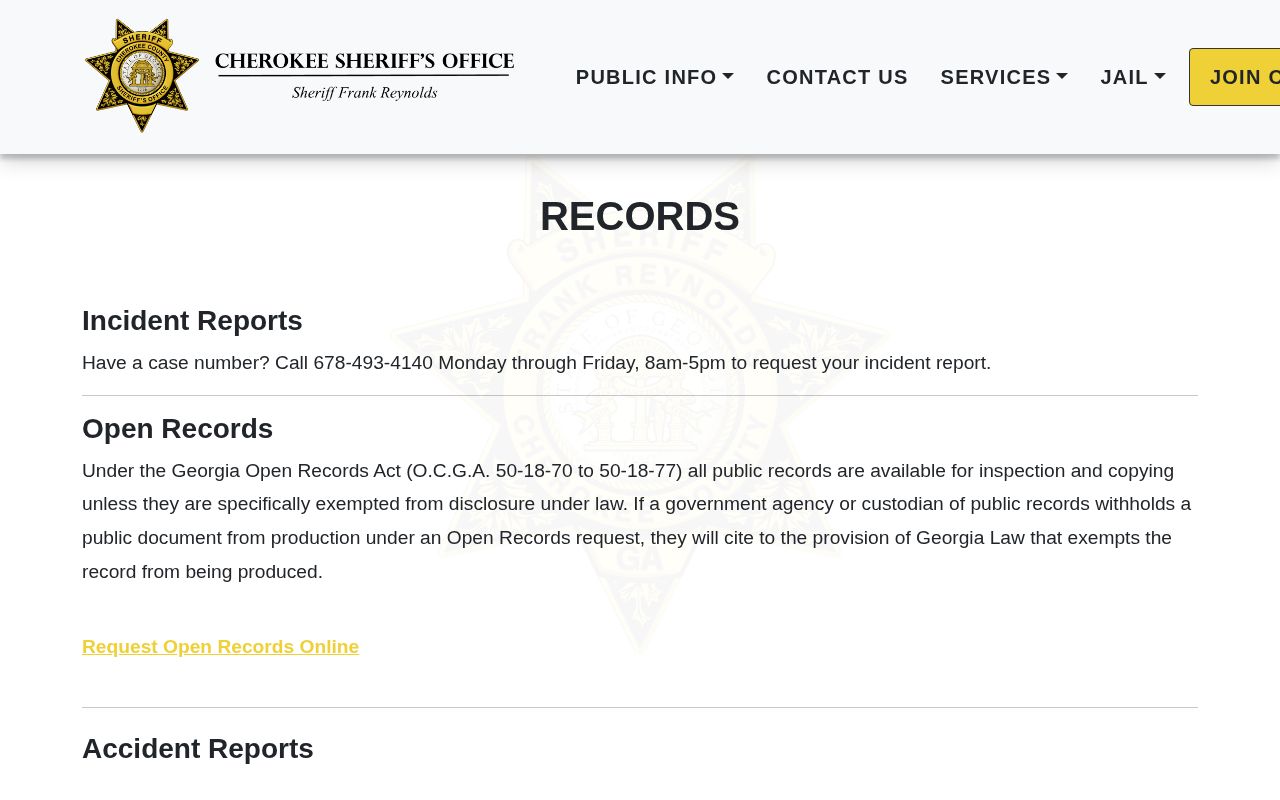
The form lets you choose inspection or delivery. Georgia law helps here: under O.C.G.A. § 50-18-71, the first 15 minutes of labor on a request are free. Cherokee's own form lists $0.10 per letter or legal-size photocopied page and authorizes work up to $25 before staff must send a further estimate. Electronic delivery trims copy costs. Keep in mind the three-business-day rule guarantees a response or availability determination, not full production of a broad, redaction-heavy request.
Use this order for a person-specific request:
- Identify the full name, approximate booking date, inmate or booking ID, and arresting agency.
- Request the existing booking or intake record and booking photograph as separate items.
- Ask for electronic delivery or inspection, and request an estimate before costs exceed $25.
- Record the request number and ask the custodian to identify any exemption, redaction, disposal, or other agency holding the record.
For a date range, request the existing booking log with inclusive start and end dates. Ask only for the fields already maintained in it. Don't ask the sheriff to build a new list. A date-bounded log helps reconstruct released bookings that the current roster no longer shows. Any photo request should stay tied to one specific booking.
Georgia Busted Mugshot Law and Removal
Georgia leans toward openness. The Open Records Act, O.C.G.A. §§ 50-18-70 through 50-18-77, covers photographs, computer data, and most other held information, though it carves out exemptions and redaction rules. A second statute, O.C.G.A. § 35-1-19, governs booking photos specifically. It bars law enforcement from posting them online in most cases. Anyone requesting a photo for an approved purpose must submit a written affirmation that meets the statute. That is why the Cherokee roster shows names, charges, and bond amounts but no faces.
A blank where a photo should be tells you little. It does not mean no picture was taken. The sheriff reviews each request under the statute and may withhold, redact, or report no responsive image. Juvenile, sealed, medical, victim, and active-investigation material faces its own limits. A missing roster entry is never proof that an arrest failed to happen or that a record was destroyed.
Separately, O.C.G.A. § 10-1-393.5 gives Georgia's Attorney General a no-charge removal path tied to case outcomes. Qualifying outcomes include dismissed charges across the board or an acquittal. A compliant written demand can then force a commercial publisher to pull the image within 30 days. The demand must name the person, date of birth, arrest date, and arresting agency, and it must travel by the delivery method the statute sets. This remedy targets qualifying outcomes only. It cannot wipe a current custody record. A publisher's free route, a fix at the original custodian, a court restriction, and a search-engine refresh each stand apart.
Fixing a wrong Cherokee record starts local. Bring the booking date and proof to the sheriff or the arresting agency. The court and prosecutor control their own data. GCIC handles correction or restriction under its own rules. Georgia calls the remedy record restriction, not expungement. Restriction limits some sharing, but it cannot force every publisher or search engine to drop its copy. The Attorney General's mugshot website guidance and the GBI restriction information spell out those boundaries. Skip any third party charging a fee for a promised result, and never use a removal request to dodge the booking-photo affirmation.
RecentlyBooked offers its own no-charge request for a qualifying page. It asks for the page URL, a name, the arrest date, county, a reason, and supporting documents. That route is voluntary and separate from the Georgia statute, and it does not make a page official. Fix the source record and the court outcome first, then use whatever free publisher process fits.
Juvenile and Restricted Records
Juvenile matters stay closed. GBI confirms that juvenile, restricted, and sealed records are left out of public criminal-history dissemination, and the adult ADC audit's age range cannot open a juvenile case to the public. A name missing from JailList or a public history proves nothing. Withheld or redacted details can include Social Security numbers, medical information, financial accounts, parts of birth dates, and protected addresses or phone numbers.
For a youth case, contact the juvenile-court custodian. Access still depends on confidentiality law. Never try to identify a child through an adult booking page or a copied third-party entry.
Older Cherokee Busted Records
A record's life online is not its life in a file. Under Georgia Archives schedule LG-19-060, jail booking records and their associated data are kept for 10 years after release. Jail registers and inmate files get the same 10-year span; incarceration lists run shorter. Booking photographs are not named in the schedule. Whether an image counts as associated booking data is only an inference. Ask the Cherokee Sheriff's Office which series applies and whether a record was retained, disposed of, or transferred.
History requests begin with CSO and the Clerk of Courts. From there, the Georgia Archives public-safety schedule identifies each series by name and date. The Archives' Central Register of Convicts tracks older state corrections history, not current Cherokee bookings. Retention never guarantees web display. A schedule expiring does not prove a record was destroyed.
Find Cherokee County Busted Mugshots
Where you look depends on the custody stage. The JailList shows whether someone is held at the ADC right now. A records request works once that person is gone, pulling a booking or release file. The Clerk's docket tracks where a case stands in court, and the Georgia Department of Corrections search covers state custody. Federal and immigration locators sit on entirely separate systems. Work through each step below. One copied page is never a full arrest history.
- Search the official Cherokee JailList with a full or partial name. Read the booking date, agency code, charges, and bond display.
- If the person was released, request the named booking record, date-bounded log, or specific booking photo from the sheriff.
- Request the incident or arrest report from the agency that made the arrest. City routes are different from the jail route.
- Check the Cherokee Clerk's case search for the filed case, amended charge, plea, dismissal, sentence, or other disposition.
- If facts point to state-prison custody, use GDC. If facts point to federal or immigration custody, use the matching federal locator.
Timing matters here. A quick release can leave no trace on the current roster. A longer stay may stay visible well past the booking date. A secondary page might fill that gap, though its image, identity, charge text, and release status all still need official confirmation.
Where Cherokee Busted Mugshots Appear
Start with official channels. The table separates a live custody result from a record request and from secondary coverage. No official 24-hour, 48-hour, 72-hour, weekly, released-person, or historical photo feed turned up. And a third-party entry saying "photo" proves nothing about the image's origin. It may never have come straight from Cherokee County.
| Channel | Photo? | Authority | Access |
|---|---|---|---|
| Sheriff JailList | No portrait in results | Official | Current ADC custody, name-contains search |
| Sheriff records request | Request separately | Official | NextRequest, named person/date/booking |
| Sheriff app | Unverified | Official | Inmate search, jail services, requests, alerts |
| GDC Find an Offender | May display GDC image | Official state | State sentenced custody or supervision |
| Cherokee court file | Not a booking-photo feed | Official court | Case posture and disposition |
| Local news | Variable | Secondary publisher | Event-driven stories, not a complete log |
| RecentlyBooked | Claims photos | Unofficial | Last-30-days section; provenance is inconsistent |
News sites and aggregator pages have their uses. They can help pin down a booking date. They can confirm a name's spelling. Still, they lag behind releases, mix up people with similar names, and sometimes keep posting an outdated photo. So treat them as leads, not answers. The sheriff can confirm who is actually in custody, and the Clerk can tell you how a case ended. Neither Arrests.org nor Mugshots.zone had a confirmed Cherokee section during the period covered here.
Cherokee Busted JailList Roster Search
The sheriff's JailList inmate search opens with a warning worth heeding. Anyone calling to demand bond money, ankle-monitor fees, or pretrial-release payments is running a scam. The search itself is simple. One field matches any name containing your text. Results come back newest booking first. Keep in mind the list shows who is held now, not every arrest ever made.
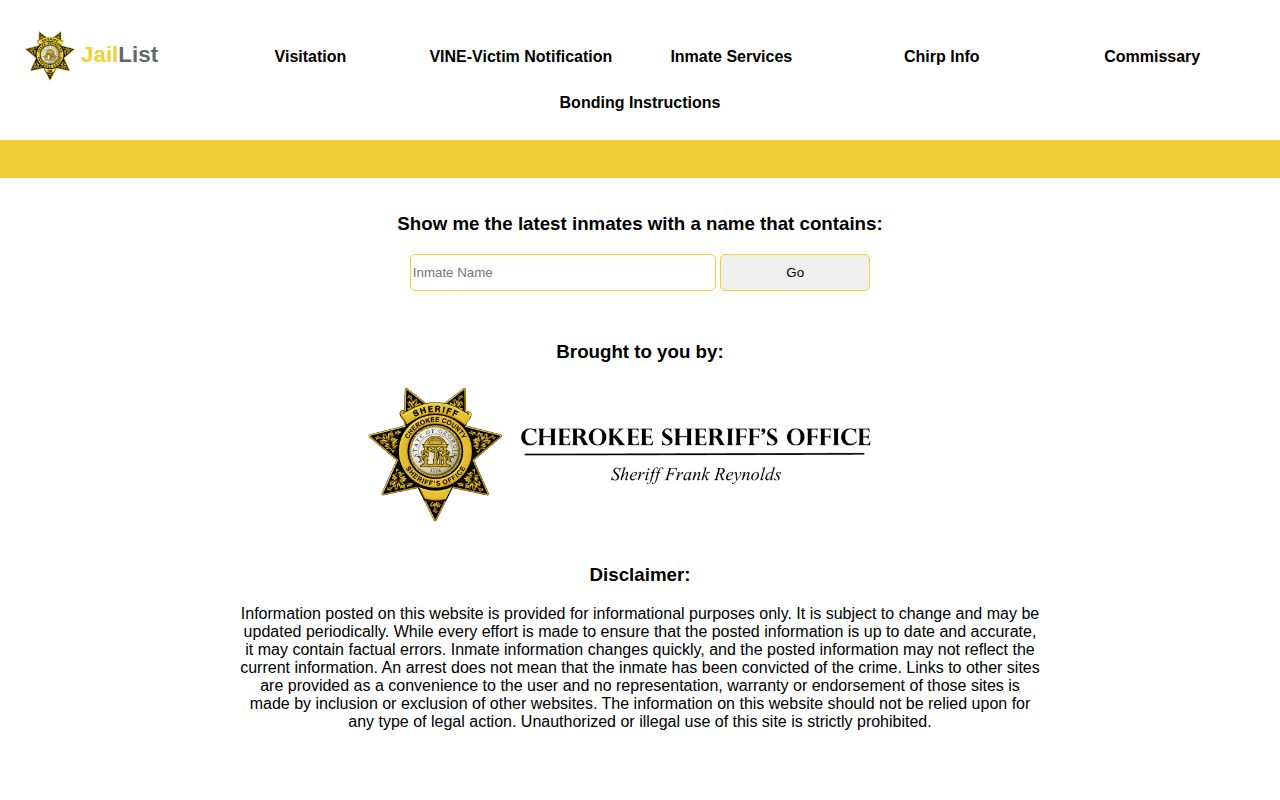
| Search or result item | Cherokee behavior |
|---|---|
| Name search | One text field accepts a whole or partial name. |
| Sort order | Newest booking date first in the live results. |
| Shown | Inmate ID, booking ID, name, booking date, agency code, charges, and bond amount or status. |
| Not shown | Portrait, released tab, disposition, guaranteed release date, physical description, or court schedule. |
| Cadence | Information changes quickly and is updated periodically; no numeric interval is published. |
Type the name. Then check the arresting agency and booking date against what you already know, since shared names are common. The bond figure tells you what it takes to get out. Keep timing in mind, too. Someone who bonded out fast will drop off a later search, while a person still sitting in the ADC stays visible long after the arrest made news.
- Open JailList after reading the sheriff's fraud warning.
- Enter enough of the name to narrow the results, then compare the booking date and arresting agency.
- Save the inmate or booking ID if a records request or court search will follow.
- If no result appears, do not treat that absence as proof of no arrest. Use the records-request fallback for a released or older booking.
Busted Last Night in Cherokee County
No same-day or rolling 24/48-hour booking feed exists for Cherokee County. There is no official 72-hour list, weekly report, released-person roster, or historical archive either. Woodstock, Canton, and Holly Springs post no fixed municipal blotter. The JailList looks like an arrest log at first glance because it runs newest booking first. It is not one. It shows current custody only. People released quickly vanish from view, while long stays linger with no fixed window or published refresh interval.
Feed windows: No official same-day, 24-hour, 48-hour, 72-hour, weekly, released-person, or historical booking feed exists here; JailList is simply a current-custody list sorted by booking date.
Want records for a set stretch of days? Ask the custodian with inclusive dates. Request the fields already kept in the existing log. Don't ask for a new ranking or a photo gallery, because that invites a denial. This matters most after weekends and holidays, when a list built on who is still held misses everyone who bonded out fast.
Cherokee Sheriff's Mobile App
The sheriff's office also has a mobile app. The official Cherokee Sheriff's Office, Ga app bundles the ADC inmate search with jail services, records requests, tip submission, wanted-suspect notices, missing-person alerts, and public-safety messages. The sheriff's 2024 report counted over 5,000 downloads in its first year. One caveat applies. Official descriptions never confirm that inmate results include photos, so don't count on mugshots there until the app itself shows them.
Know what the app is not. It is not a released-person archive. It is not for emergencies. Georgia VINE serves the custody-notification role, while Cherokee EMA's Rave system handles weather, traffic, and geographic emergency alerts.
Georgia DOC Offender Photos
State prison is not county jail. Different system, different records. The Georgia Department of Corrections Find an Offender search covers people in state custody now or in the past. Have a GDC ID? Enter it. Otherwise search by name, description, or case number. One catch: a full surname can fail. GDC itself suggests typing the first four letters and selecting all offenders. A profile may show a corrections photo. That picture comes from state custody, though, and may not match the original Cherokee booking photo.
GDC has sharp limits, too. It will not list someone booked yesterday, released on bond, held only at the ADC, or handled in municipal court. A blank result does not mean no Cherokee arrest happened. Some images are simply unavailable or not yet uploaded, the search warns. Need a specific existing record? Use GDC's open-records route rather than asking it to build a profile.
Busted, Released, or in GDC
Which system can answer you depends on where the person sits in the process. One arrest can travel through several custodies over time. A local booking might lead to release, court supervision, a state prison, or federal custody. The tools below track different stages. None of them substitutes for another.
| Custody state | Best source | What it answers |
|---|---|---|
| Currently held at ADC | Cherokee JailList | Whether the person is presently listed, with booking and bond fields. |
| Released from ADC | CSO records request | Whether a retained booking, release event, or specific photo can be produced. |
| Case in court | Cherokee Clerk of Courts | Filed charge, amendment, plea, dismissal, sentence, and disposition. |
| Sentenced to state custody | GDC offender search | State correctional location or profile, where available. |
| Federal custody | BOP or ICE locator | Federal prison or immigration detention, not a county booking photo. |
Getting out is not the same as a case ending. Someone can walk out of the ADC while charges are still pending. A later state or federal listing reflects a whole different custody system. So check before you match. Compare the name against dates, agency, case number, or a government ID before deciding two entries describe one person.
Cherokee Court Dispositions
Booking and disposition answer different questions. Booking is an executive-branch custody event. Disposition is what the court eventually decides. To find it, search the Cherokee Clerk of Courts case-search page with the person's name and any case number tied to the booking. The Clerk calls its online interface a convenience. It shows overall posture, not the retained official file. A filing on the docket is not yet a final order.
Cherokee Magistrate Court handles first appearances and bail around the clock. Local material points to an appearance within 72 hours. Uniform Superior Court Rule 26.1 sets the outer limit: 48 hours after a warrantless arrest, 72 hours after a warranted one, unless bond comes first. At that hearing a judicial officer explains the charges and the person's rights and may take up bail.
Read how the case ends. Booking charges get amended, reduced, dismissed, or resolved by plea all the time. The docket and final disposition carry far more weight than a copied booking entry ever will.
- Booking
- Intake into jail after an arrest.
- Bond
- A condition or payment tied to appearing in court, not a fine or guilt finding.
- Arraignment or first appearance
- A court event where charges and rights are addressed; the exact event depends on the court.
- Disposition
- The court's result, such as dismissal, plea, verdict, or sentence.
- Record restriction
- A Georgia remedy that limits certain dissemination; it does not automatically destroy every copy.
Cherokee's Court Portal Caveat
Think of the Clerk's online portal as a convenience, not the file itself. It lists parties, dates, the assigned judge, and where a case stands. Common names demand careful matching. Does an online result look thin or clash with a booking record? The real fix is the retained court file at 90 North Street, Suite G-170, Canton. Copies and booking photos come from different custodians, so send each request to the right office.
Court routing follows the charge. Felonies land in Superior Court. Misdemeanors go to State Court. City-ordinance and traffic matters belong in municipal court. A booking label alone will not pick the venue. Canton handles its municipal matters through the city police and its own court, while state charges live in the county court records.
Busted Alerts for Cherokee Custody
Three alert services, three jobs. Georgia VINE pushes custody-status notices when someone is arrested, released, or escapes. The sheriff's app adds a county inmate search along with wanted notices, tips, and public-safety messages. Cherokee's Rave system covers weather, traffic, hazards, and evacuation alerts by geography. Rave has nothing to do with jail status.
None of this replaces the docket or a records response. A notification confirms that custody changed, full stop. It will not produce a booking portrait or resolve a charge.
Federal Custody Is Different
Federal custody runs on separate systems. The Bureau of Prisons locator reaches federal inmates back to 1982, searchable by register number or other supported identifiers, and returns location, age, sex, and release-date fields. It publishes no inmate photographs. Gaps exist, too: someone released from BOP may still sit in another authority's jail, and pretrial federal defendants may not surface at all because the U.S. Marshals tracking system is not a public nationwide tool.
The ICE Online Detainee Locator handles immigration detention and some recent releases. You will need an A-number plus country of birth, or exact identifying details with that country. Watch the distinction: an ICE hold on a Cherokee roster entry is not physical ICE custody. Cherokee's quarterly immigration reports are aggregate numbers, not a person-search tool. Neither locator yields a Cherokee booking photo.
Cherokee Busted Mugshots by City
Woodstock, Canton, and Holly Springs lead the county's cities by headcount. The April 1, 2020 Census backs that up. Each city keeps its own incident reports. But the sheriff's audit lists all three among the agencies that use the ADC. So a city arrest can start with a local report. It can still end up in the shared county custody system.
- Woodstock Busted Mugshots routes a Woodstock Police report to the county JailList, sheriff records request, and court disposition.
- Canton Busted Mugshots separates Canton Police newsroom and report records from the ADC booking record.
- Holly Springs Busted Mugshots explains the city records portal, the sheriff booking path, and countywide news coverage.
Search by arresting agency and booking date. Don't assume a city runs its own jail roster. The city page may name the first report custodian, but current ADC custody and the booking path run through the county systems.
Initial Appearance in Cherokee
Cherokee Magistrate Court runs initial appearances around the clock. That includes after-hours bail hearings for anyone booked into the ADC. Rule 26.1 and the local court description give a better time frame than a vague "court date" label. The hearing covers the charges, basic rights, and bail.
Timing matters here. A booking result can appear before the first appearance. Someone may walk out before anyone checks the roster again. Follow what was filed and decided in the court record. The bond line alone is not an outcome.
Pretrial Diversion and Restriction
The Blue Ridge Judicial Circuit runs a pretrial diversion program. It is discretionary and limited to qualifying nonviolent cases. Finish it successfully and the results can include plea withdrawal, dismissal, and restriction. Qualification is fact-specific, though. DUI cannot be dismissed this way. A booking page stays silent on whether diversion was ever offered or completed. For that, the court and prosecutor records are the place to look.
Cherokee Records Request Costs
Georgia law gives requesters the first 15 minutes of labor free. Cherokee's form prices pages at $0.10. It also asks for approval once estimated work tops $25. Those terms govern the county path only. Canton, for its part, charges $2 for an incident report and $5 for an accident report. Ordinary reports there are ready in five business days. None of these figures covers a booking photo.
Keep requests narrow. One named booking in electronic form is far easier for staff to handle than a demand for every photo in a date range. Name the record type. Ask for the existing fields. Then get an estimate before work crosses the threshold.
Why the Roster Has No Faces
Why no faces on the roster? O.C.G.A. § 35-1-19 supplies the answer. The law generally limits an arresting agency's online publication of booking photos and requires a written affirmation for a compliant release. That lets the sheriff keep an intake image on file while leaving it off the public JailList. A photo request should identify the booking and let the custodian apply the current rule.
A missing face does not make a third-party image official. Request the source record. Compare the booking date and the agency. That comparison tells you more than any outside site can.
First Offender Changes in 2026
Georgia lawmakers rewrote the First Offender playbook. Act 403, which began life as HB 162, takes effect July 1, 2026 and changes how restriction and sealing work. Under the new law, completing a First Offender probation sentence can lead to restriction or sealing in the situations the act covers, and there is a path for qualifying earlier discharges too. Judicial Council materials walk through those mechanics. Older summaries floating around the web may lag behind, so when timing matters, lean on the current bill status and the signed Act itself.
One thing the new law does not do is erase every booking record everywhere. A court sealing order, GCIC restriction, a correction at the source, removal by a secondary publisher, and a fresh search result are all separate steps. Each one moves at its own pace.
ICE Holds Versus ICE Custody
Cherokee Sheriff's quarterly reports, filed under O.C.G.A. § 42-4-16, put immigration questions on the local radar. But note the fine print. An ICE hold placed on someone at the ADC does not mean federal agents have physical custody. Two different locators answer two different questions here. JailList tells you who sits in the county detention center right now, while the ICE locator handles federal detention. Neither tool can tell you a person's nationality or immigration status from a name alone.
Choose the Right Record Custodian
Pick the right custodian and the records stop blurring together. The JailList handles a current Cherokee County custody check. CSO records covers released bookings and specific photos. Want the police narrative? Go to the arresting department. The Clerk of Court holds case results, GDC covers state prison, and BOP or ICE fit federal detention when the facts actually call for it. Keeping those lanes straight prevents a live jail entry, an old booking, and a later court outcome from getting tangled.
Two habits help. Start with official sources, and write down the booking date and agency so nothing gets mixed up later.